Picture a freelance designer in Jaipur who just landed her first big client. The client asks, “Is your company registered?” She freezes. Proprietorship? Pvt Ltd? She has no idea what the difference is, and a quick Google search leaves her with seven tabs open and more confusion than before.
I’ve seen this exact moment with many first-time founders. The types of business registration in India look complicated, but the choice usually comes down to three questions. Here’s a plain-language guide for 2026. Fees and rules change, so treat the numbers below as a starting point and confirm them with a CA.
What Are the Main Types of Business Registration in India?
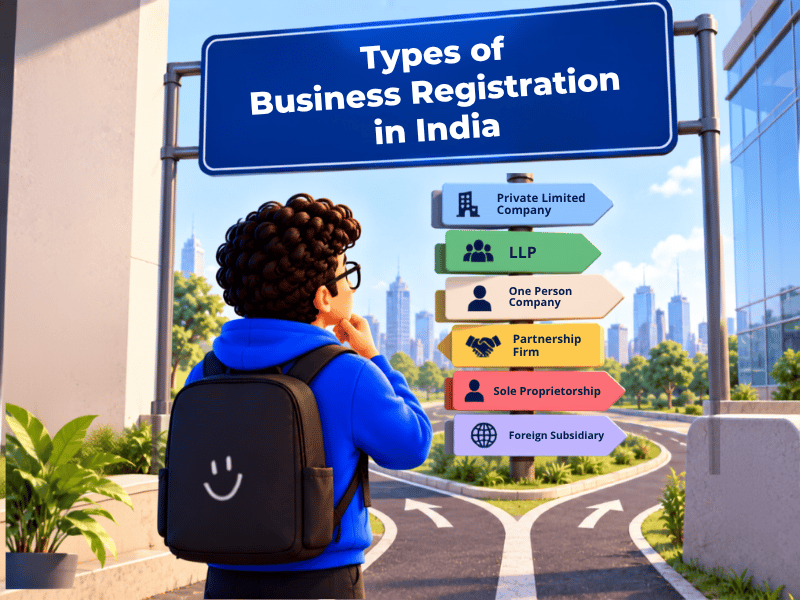
The main types of business registration in India are sole proprietorship, partnership firm, LLP, One Person Company (OPC), private limited company, public limited company and Section 8 company. Some sources count seven structures, and only the incorporated ones give limited liability protection. Others group them into six. registerkaro
Most small founders only ever look at the first five. Public limited and Section 8 (non-profit) companies are for very specific cases, so you can ignore them for now.
Sole Proprietorship: The Quick Start
This is the simplest option. One person owns and runs the business, and there’s no separate legal entity. There’s no single central form that registers a proprietorship, and business income gets taxed along with your personal income. In practice, people get a GST number, a current account and maybe a Udyam registration. taxaj
It suits freelancers, small shops and anyone testing an idea. The catch? Your personal assets aren’t protected if the business runs into debt. I think that’s fine for a low-risk side business, but risky once you’re signing bigger contracts.
Partnership Firm and LLP
A partnership firm is two or more people running a business under a deed. It’s easy to set up, but partners carry unlimited personal liability, and one partner’s mistake can hit everyone.
An LLP fixes that. It’s a separate legal entity, and your liability stays limited to what you put in. An LLP needs at least two members. Compliance is lighter than a company’s, which makes it popular with consultants, agencies and small service firms. Funded startups usually avoid it, though, because investors prefer companies. kanakkupillai
One Person Company (OPC)
An OPC is for a solo founder who wants limited liability. It fills the gap between a proprietorship, which has no liability protection, and a private limited company, which needs two shareholders. legalsuvidha
It has more paperwork than a proprietorship, such as annual filings and audits. It also has rules about conversion once your turnover or capital grows. If you’re a solo founder planning to scale, ask your CA whether OPC or a Pvt Ltd makes more sense for you.
Private Limited Company
This is the standard choice for startups that want to raise money, offer ESOPs or build a brand over many years. It’s a separate legal entity with shareholders and directors, and it needs a minimum of two members. kanakkupillai
The downside is compliance. You’ll deal with annual returns, board meetings, audits and ROC filings, which means regular professional fees. For a small side business, that’s overkill. For a funded tech startup, it’s expected.
How Much Does Each Type Cost?
Costs vary by state, professional fees and capital. One 2026 guide puts a proprietorship at roughly ₹3,000 to ₹8,000, an LLP at ₹5,000 to ₹15,000 and a private limited company at ₹10,000 to ₹23,000 all in. Treat these as ballparks, not quotes. surveyheart
Timing differs too. A proprietorship can start within days, while an LLP, OPC or private limited company usually takes one to two weeks, depending on name approval and document readiness. Ongoing compliance cost matters more than setup cost, so ask your CA for a yearly estimate before you decide. taxaj
How to Choose: Three Simple Questions
Which of the types of business registration in India fits you? Ask yourself:
- Do you need to protect personal assets? If yes, choose an LLP, OPC or Pvt Ltd.
- Do you plan to raise funding? Pvt Ltd is the safest bet.
- How much compliance can you handle? Less means proprietorship or LLP.
A quick example: a freelance writer working alone should probably start as a proprietorship. Two friends starting a consulting firm may prefer an LLP. A founder building an app for investor funding should look at a Pvt Ltd from day one.
Common Mistakes to Avoid
Don’t pick a structure just because a friend did. Don’t skip the GST check if your turnover or work type requires it. And don’t mix personal and business money, which is a quiet killer in any structure.
One more thing: you can switch later. A proprietorship can be converted into an OPC, private limited company or LLP as it grows. It costs some extra filings, so plan ahead. Choosing among the types of business registration in India isn’t permanent, but starting right saves effort. taxaj
FAQs
Which is the cheapest type of business registration in India?
A sole proprietorship, since there’s no separate company filing. You mainly pay for GST, bank and licence setup.
Is registration compulsory for a proprietorship?
There’s no single compulsory registration for the structure itself, but you may need GST, a shop licence or Udyam depending on your work.
Which structure is best for a startup?
A private limited company is the usual choice for startups planning funding. Small bootstrapped ones often start with an LLP or proprietorship.
Can I register a business alone?
Yes. You can use a proprietorship or an OPC as a solo founder.
Can I change my business structure later?
Yes. Proprietorships and partnerships can convert to an LLP or company, though it involves fresh filings and costs.
Do I need a CA to register?
Not legally for every type, but for LLP, OPC and Pvt Ltd, a CA or company secretary makes the process far smoother.
Conclusion
To sum up: proprietorship for a simple, low-risk start, LLP for small partnerships, OPC for solo founders wanting limited liability, and Pvt Ltd for funded growth. The right pick among the types of business registration in India depends on liability, funding plans and how much compliance you can handle. Write down your answers to the three questions above, then book a short call with a CA to confirm the costs for your state. If you’re stuck between two options, tell us in the comments and we’ll help you compare them.
Note: This is general information, not legal or tax advice. Rules, fees and thresholds change, so check current details with a CA or the relevant government portal before you register.
Internal link suggestions:
- [link to how to write a business plan guide here]
- [link to a post on GST registration for small businesses here]
- [link to an article on how to start a small business in India here]
Image alt text:
- “Comparison chart of types of business registration in India”
- “Founder reviewing LLP and private limited company documents with a CA”
- “Small business owner in Jaipur filling a company registration form”